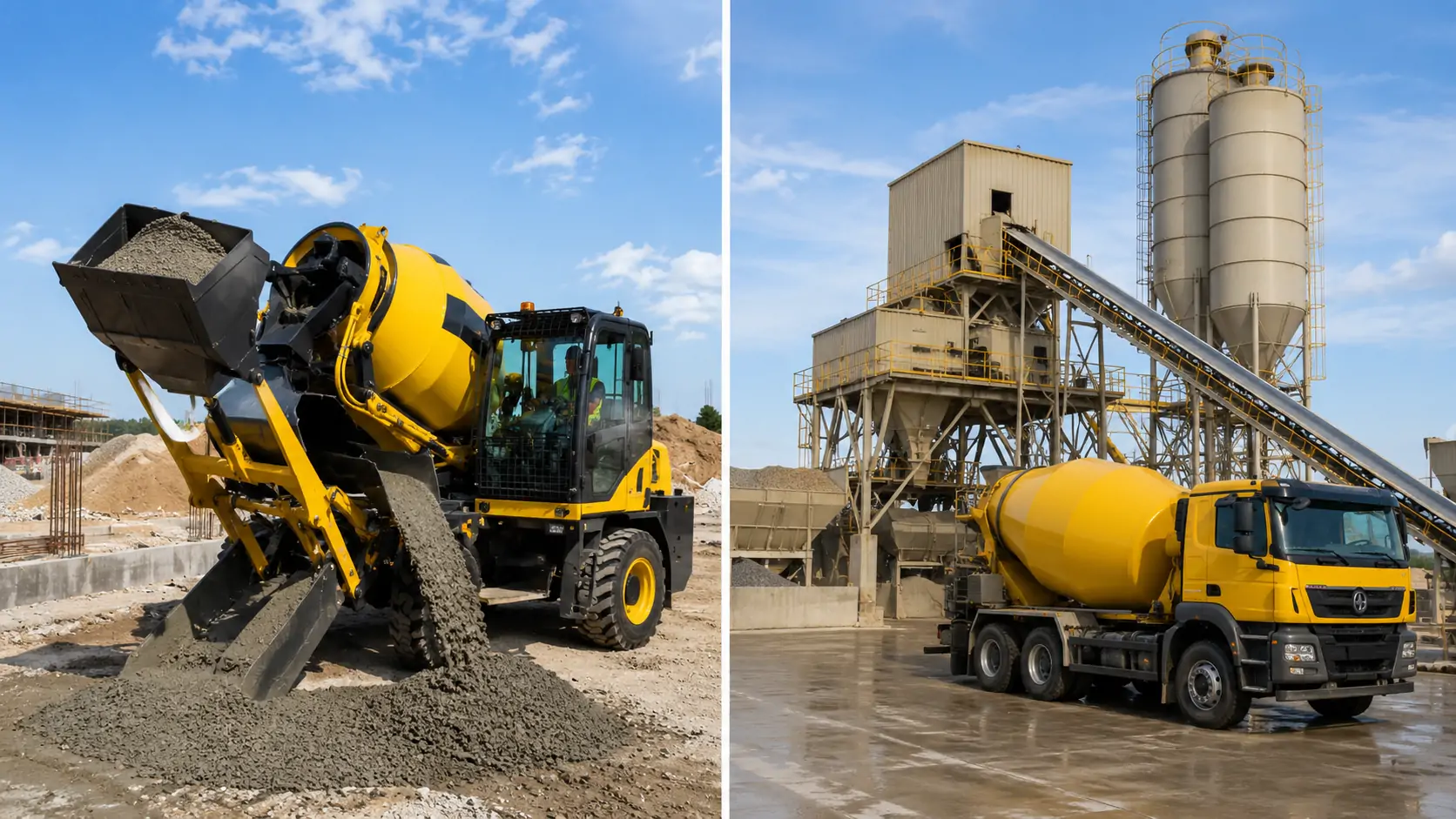
Self loading concrete mixer vs traditional mixer is a common comparison for contractors, dealers and project buyers who need to choose the right concrete mixing solution. Both machines can produce concrete, but they differ in loading method, mobility, labor demand, site flexibility, capacity and long-term operating cost.
Thank you for reading this post, don't forget to subscribe!
Choosing between a self loading concrete mixer and a traditional concrete mixer is not only a question of machine price. For contractors, dealers and fleet buyers, the right decision depends on jobsite distance, labor availability, batch volume, road access, project schedule and after-sales support.
A traditional concrete mixer can work well when a project already has a batching plant, loading equipment and stable ready-mix supply. A self loading concrete mixer is different. It combines loading, water intake, mixing, short-distance travel and discharge in one mobile machine, so it can produce concrete directly at the construction site.
XQ Machinery supplies a 0.8-5.0 m3 self loading concrete mixer range for contractors and dealers who need practical equipment for roads, buildings, rural construction, farm projects, drainage work and remote jobsites.
Main equipment range: self loading concrete mixer manufacturer
Quick Comparison
| Item | Self Loading Concrete Mixer | Traditional Concrete Mixer |
|---|---|---|
| Main function | Load, mix, transport and discharge on site | Mainly mix or transport concrete |
| Extra equipment needed | Usually less supporting equipment | Often needs loader, batching plant or ready-mix supply |
| Best fit | Remote sites, scattered projects, contractors moving between jobs | Fixed sites, high-volume ready-mix supply, plant-based projects |
| Labor demand | One trained operator can handle several steps | More operators and supporting machines may be needed |
| Mobility | Built on a mobile 4WD chassis | Depends on mixer type and site logistics |
| Batch control | Can batch on site, optional weighing available | Depends on external batching setup |
| Export buyer concern | Capacity, drivetrain, service parts, water system, operator comfort | Mixer volume, plant access, truck supply, site feeding method |
What Is a Self Loading Concrete Mixer?
A self loading concrete mixer is a mobile concrete production machine. It uses a front bucket to load aggregate and other materials, an onboard water system to add water, a rotating drum to mix concrete, and a discharge chute to place concrete where the jobsite needs it.
For buyers comparing self loading concrete mixer vs traditional mixer options, the important difference is independence. The self loading unit can reduce dependence on a separate wheel loader, small batching plant, transit mixer and manual feeding crew.
XQ’s current self loading concrete mixer range covers 0.8 m3, 1.5 m3, 2.0 m3, 2.6 m3, 3.5 m3, 4.0 m3 and 5.0 m3 discharge capacities. This gives contractors a practical capacity range from compact jobsites to heavier construction work.
Related article: How does a self loading concrete mixer work?
What Is a Traditional Concrete Mixer?
A traditional concrete mixer can mean several types of equipment: a small drum mixer, a fixed mixer, a concrete mixer truck, or part of a batching plant system. These machines can be effective, but they usually depend on external material loading, plant arrangement or ready-mix delivery.
For stable urban projects close to a batching plant, a traditional mixer or ready-mix truck may be efficient. For rural roads, remote construction, small bridges, farms, scattered house building and jobs where concrete demand changes every day, the traditional setup may become slower because every part of the workflow depends on another machine or supplier.
When a Self Loading Concrete Mixer Is Better
1. Remote Construction Sites
Remote sites often have limited access to ready-mix concrete. Delivery time can affect concrete quality, and waiting for trucks can delay the crew. A self loading concrete mixer allows the contractor to produce concrete near the pour location, which is useful for rural roads, small bridges, foundations and drainage work.
2. Projects With Frequent Relocation
Some contractors move between several small jobs in the same week. In this case, a mobile machine with loading, mixing and discharge functions can reduce setup time. XQ models use full-time 4WD drive axles across the series, with smaller JBJ-8T axles on compact models and JBJ-20T on the 5.0 m3 model.
3. Lower Supporting Equipment Requirement
Traditional concrete production may need a loader, mixer, water source, batching arrangement and transport vehicle. A self loading mixer integrates more steps into one machine. This does not remove the need for trained operation, but it can simplify equipment planning for small and medium contractors.
4. Better Control Over Small and Medium Batches
For many contractors, the problem is not maximum plant output. The problem is having the right amount of concrete at the right time. A self loading mixer lets the operator produce one batch and discharge it directly on site. XQ machines use timed water intake as a standard feature, while electronic weighing can be selected when the buyer needs more repeatable batching.
5. Practical Capacity Range
XQ’s 0.8-5.0 m3 range helps buyers match machine size to work type:
| XQ Capacity | Typical Buyer Fit |
|---|---|
| 0.8-1.5 m3 | Small construction teams, farms, narrow access projects |
| 2.0-2.6 m3 | General building, rural roads, drainage and small contractor fleets |
| 3.5-4.0 m3 | Medium contractors needing stronger daily output |
| 5.0 m3 | Larger jobsite batches and heavy-duty contractor use |
For the largest model, see the XQ-SM500 5.0 m3 self loading concrete mixer.
When a Traditional Mixer May Still Be Better
A traditional mixer is not always the wrong choice. It can be better when the project has high-volume continuous concrete demand and a stable batching plant nearby. If the site already has loaders, material bins, weighing systems, mixer trucks and a trained team, a traditional plant-based system may produce more concrete per day.
Traditional mixers can also be simpler for buyers who only need a fixed mixing station and do not need road mobility, self-loading or 4WD jobsite travel. For large commercial concrete supply, a dedicated batching plant and transit mixer fleet is usually a different category of investment.
The key point is to match the machine to the work. A self loading mixer is usually stronger for flexible on-site production. A traditional setup is usually stronger for fixed, continuous, high-volume supply.
Cost Factors Buyers Should Compare
When comparing the two options, do not only compare the machine price. Contractors should also calculate:
- Extra loader cost
- Extra operator cost
- Batching plant or site setup cost
- Ready-mix delivery distance
- Waiting time for concrete trucks
- Fuel and maintenance for supporting equipment
- Spare parts access in the local market
- Training and daily maintenance requirements
For export buyers, the practical question is often total jobsite cost, not just purchase price. A self loading concrete mixer may cost more than a simple drum mixer, but it can reduce the number of supporting machines needed for many small and medium jobsites.
Key Specifications to Check Before Buying
Before choosing between self loading and traditional equipment, ask the supplier for clear specifications:
| Specification | Why It Matters |
|---|---|
| Discharge capacity | Determines practical batch size |
| Tank volume | Shows mixing drum size and model class |
| Engine model and rated power | Affects performance, fuel use and parts planning |
| Drive axle and tyres | Important for muddy or uneven jobsites |
| Water tank capacity | Affects batching convenience |
| Weighing option | Useful for repeatable mix quality |
| Discharge chute and slewing | Affects placement flexibility |
| Cleaning system | Important for daily maintenance |
XQ machines use a 20 r/min mixer speed across the series, pneumatic dual-circuit brakes, and maximum travel speed up to 35 km/h. Models from 2.0 m3 to 5.0 m3 list 40 degree gradeability and include 270 degree slewing support.
Recommendation by Buyer Type
For small contractors, a compact 0.8-1.5 m3 model can reduce manual work and improve flexibility on narrow sites.
For general construction contractors, 2.0-2.6 m3 models are often a practical middle range for house building, road repair, drainage and small infrastructure work.
For dealers and rental fleets, 3.5-4.0 m3 models may be easier to position as versatile machines for many contractor types.
For heavy-duty buyers who want the largest XQ model, the 5.0 m3 self loading concrete mixer is the flagship option, with an 8.28 m3 tank volume, 1100 L water tank, YTO 6105 Turbo standard engine and optional Weichai 6105 Turbo configuration.
For a wider model selection process, read the self loading concrete mixer buying guide.
Price is also an important factor when comparing equipment options. Our self loading concrete mixer price guide explains the main cost factors, including capacity, configuration, shipping terms and long-term maintenance support.
Final Decision
Choose a self loading concrete mixer if your project needs mobile on-site batching, fewer supporting machines, flexible relocation and better control over small to medium concrete batches.
Choose a traditional concrete mixer or plant-based setup if your project has fixed high-volume production, reliable ready-mix supply and existing support equipment.
If you are comparing models for export, dealership or contractor use, XQ Machinery can help match capacity, engine, water system, discharge configuration and optional weighing system to your jobsite conditions. Contact XQ Machinery for model recommendations and export support.
If you are comparing mixer options for projects in Nigeria, see our self loading concrete mixer Nigeria guide for practical advice on capacity, 4WD performance, supplier selection and after-sales support.